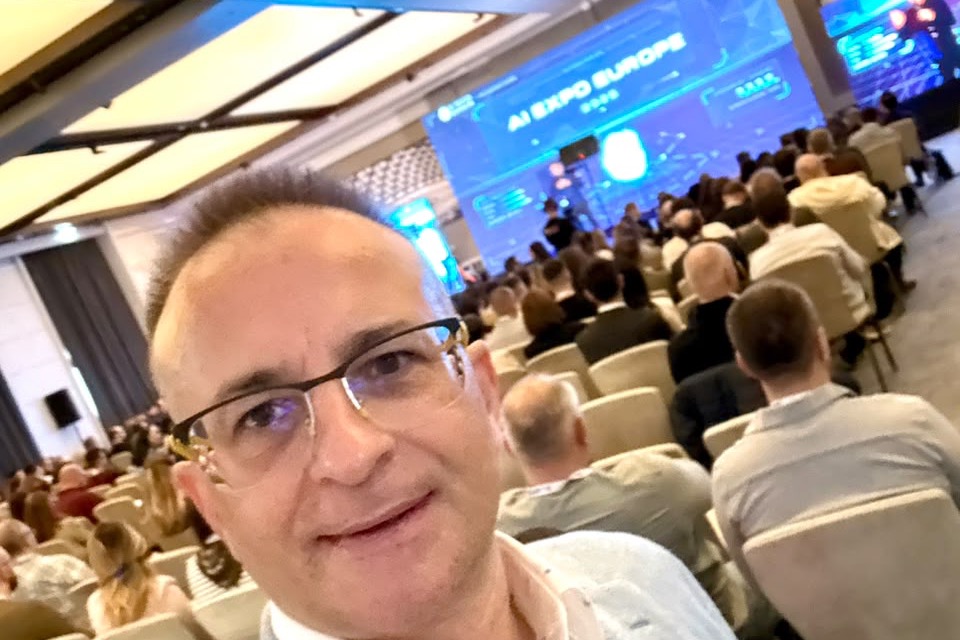
On 1 November I turned my back to the main stage and took a selfie. Behind me, the hall at the Radisson Blu was full. That was when I knew the third edition of AI Expo Europe was our biggest yet.
I am writing this a day later, as one of the event’s co-founders. I have put together what I saw myself and what participants, speakers and exhibitors have been posting since. That feels more honest to me: an organiser sees the event from backstage, while participants see it from the room.
The 2026 edition in numbers
We have grown every year, and 2026 brought our largest attendance so far. In short:
- more than 2,000 attendees from over 50 countries and more than 300 companies, across more than 20 industries;
- more than 100 speakers;
- 87 sessions, including 55 keynotes and 13 live demos;
- more than 50 sponsors and exhibitors and over 20 workshops.
On stage we had people from NVIDIA, IBM, Microsoft, Google, Oracle, Adobe, Alibaba Cloud, Salesforce, KPMG and ING. For a conference held in Bucharest, that line-up would have been hard to imagine three years ago, when we started AI Expo Europe.
Four tracks, four ways of looking at AI
This year we split the programme into four tracks. We wanted every participant to find something that fits them: the manager who decides the budget, the developer who builds, the lawyer who has to warn them both and the student who is just starting out.
- Main Stage. Keynotes and panels on where AI is heading: the global AI race, cybersecurity in an age of automated attacks, AI in defence, and a discussion I consider essential, about protecting children from deepfakes and manipulation.
- AI in Action, the demo stage. Applications already working inside companies, shown live rather than on slides.
- EU AI Act Stage. Regulators, lawyers and industry people discussed what you can legally build in Europe and how to stay compliant. I have written about the AI Act before.
- School Robotics Expo. Students and robotics teams showed what they are building. For me it was the most reassuring corner of the event.
We opened the conference differently this time: with a conversation with a humanoid robot about how AI sees its own future. It felt like the most honest way to open an AI conference: let the technology speak, then ask it what we want to know.
What participants saw
After the event I read dozens of LinkedIn posts, and a few ideas kept coming back.
From “using AI” to “building with AI”. One participant wrote that interest is moving beyond improving existing workflows or adding an AI agent to a platform, towards products where AI is a core capability. That takes product thinking and solid engineering, not just access to a model. I fully agree, which is why I wrote that AI agents are the next step.
Trust. A speaker on the AI Act stage noted that everyone in the room, from regulators and academics to industry, wanted the same thing: AI you can trust. I think that is the most important takeaway of this edition.
Adoption is still the problem. Someone else left with a short list: we have talent, very good students already building impressive things, we have institutions and a regulatory framework taking shape, we have experience. But we talk too little about non-technical people, the entrepreneurs and employees who need to learn how to use AI in their everyday work. That is a fair criticism, and I am taking it as a theme for the next edition.
The Romanian paradox. One exhibitor started from something we keep hearing: Romania has one of the lowest rates of AI adoption in companies in Europe, yet AI is starting to arrive exactly where implementation is hardest, in public administration.
The corridors and the expo floor were just as busy as the stages. There were stands with virtual assistants and AI avatars, discussions about who really owns our data, and a Formula 1 simulator with a permanent queue: more than 100 drivers signed up and over 250 laps on the second day alone. A group of colleagues who came “for inspiration” joked that they were going home with 27 new ideas and 5 use cases. For an organiser, that is the best review there is.
What I learned as an organiser
After our first year and the 2025 edition I thought I already knew everything that matters. I learned three more things.
- Demos beat presentations. That is why this year we had a whole stage dedicated to live demos. People want to see how it works, not hear once again that “AI changes everything”.
- Regulation no longer scares people, it interests them. Two years ago the AI Act was a niche topic. This year it had a whole stage, with an audience.
- Networking is the product. In many posts after the event, people wrote more about who they met than about the talks. When 80% of attendees are decision-makers, corridor conversations turn into projects.
Thank you
Above all, thank you to my co-founder Ruxandra Tataru, CEO of AI Expo Europe, who made all of this happen together with our permanent team. Thank you to the whole team, who worked for months on two days that went by far too quickly. Thank you to the speakers who came from all over Europe and beyond, to the partners and exhibitors who believed in the project, and to every participant who spent a Sunday and a rainy Monday with us at the Radisson Blu.
Before the event I wrote about what comes after the hype. Having seen the rooms, I think we have the answer: the work comes next, and far more people are ready to do it than I thought. See you at the next edition.